Mapping Responsible Gambling Tools to Roulette Strategies in Quebec's Regulated Online Environments
Alex Beck · Sep 18, 2026

Mapping Responsible Gambling Tools to Roulette Strategies in Quebec's Regulated Online Environments
Quebec's regulated online gambling sector has developed specific frameworks that connect responsible gambling features directly to common roulette approaches, and operators must align these tools with player activity on licensed platforms, while data from the Régie des alcools, des courses et des jeux shows steady growth in mobile roulette participation through September 2026.
Regulatory Context in Quebec's Online Spaces
Provincial statutes require licensed sites to embed limit-setting functions and session monitoring into every roulette variant, and these mandates create structured environments where players encounter prompts before extending play sessions or increasing stakes, whereas unlicensed platforms operate without such requirements.
Updates scheduled for September 2026 introduce enhanced reporting on tool usage rates, which will track how deposit caps interact with progressive betting patterns across different wheel formats.
Core Responsible Gambling Features Available
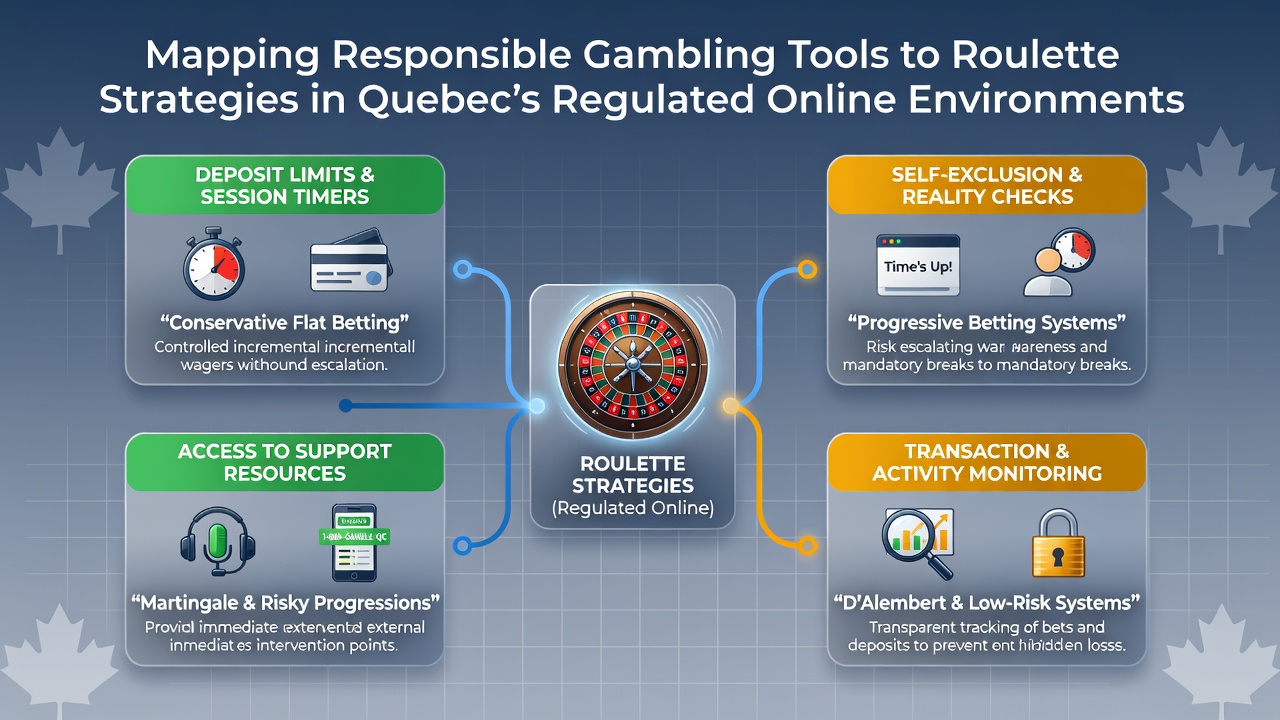
Deposit limits, loss thresholds, time-based reminders, and temporary self-exclusion options form the primary set of controls that licensed operators provide, and each feature activates at the account level so that roulette-specific bets trigger the same safeguards as other games.
Reality checks appear at fixed intervals during live-dealer sessions, and cooling-off periods block access to new wagers once a player reaches preset markers, while self-exclusion registers feed into a centralized database shared among Quebec operators.
Roulette Approaches Commonly Used on Licensed Sites
Players frequently apply structured betting sequences such as the Martingale progression, the D'Alembert system, and flat-bet patterns that emphasize consistent stake sizes, and these methods rely on bankroll allocation that responsible gambling tools can monitor in real time.
Systems that double stakes after losses require larger reserve amounts, and platforms record these patterns to flag deviations from earlier deposit settings, whereas flat betting tends to align more easily with static loss limits.
Aligning Tools with Specific Betting Patterns
Deposit caps map directly onto Martingale users by halting additional wagers once a daily or weekly ceiling is reached, and loss thresholds interrupt D'Alembert sequences before cumulative deficits exceed the chosen boundary, while time reminders interrupt extended sessions that often accompany progressive systems.
Self-exclusion periods offer longer-term separation for individuals whose roulette activity shows repeated limit breaches, and operators generate anonymized reports that link tool activation rates to strategy types without identifying individual accounts.
Data Patterns and Platform Implementation
Figures released by the Canadian Centre on Substance Use and Addiction indicate that limit-setting tools see higher activation among players who employ stake-progression methods, and these same reports note that time-based reminders reduce average session length across all roulette formats by measurable margins.
Platform dashboards display remaining bankroll relative to chosen limits, and such displays help players maintain awareness during sequences that increase exposure, whereas automated pauses after reality checks give users an opportunity to reassess before continuing.
Research from the Australian Gambling Research Centre has examined how regulatory-mandated features interact with common casino games, and findings show consistent uptake when tools appear at the point of bet placement rather than after the fact.
Future Adjustments Scheduled for 2026
September 2026 marks the rollout of updated compliance metrics that will require operators to publish aggregate data on how often roulette players adjust their limits mid-session, and these metrics will cover both land-based-linked online accounts and standalone mobile platforms.
Integration testing between self-exclusion lists and live-dealer interfaces continues, and the resulting protocols aim to ensure that any strategy shift attempted during a restricted period meets automatic blocks without manual intervention.
Conclusion
Quebec's approach demonstrates clear linkages between available responsible gambling functions and the mechanics of popular roulette strategies, and ongoing regulatory refinements through 2026 will further standardize how these connections appear across licensed environments, while data collection efforts provide ongoing visibility into usage trends without compromising player privacy.